About
Cabinetmaker: Niels Vodder (1892–1982)
Location: Copenhagen, Denmark
Primary Designer: Finn Juhl
Collaboration: Contact began around 1936; the pair began exhibiting together at the Cabinetmakers’ Guild Exhibition in 1937. Their long-term collaboration ended in 1957.
Current Status: The historic workshop is no longer operating.
Story
Niels Vodder (1892–1982) was one of the master cabinetmakers associated with the development of mid-20th-century Danish furniture. He is best known today for his long collaboration with Finn Juhl.
Juhl approached Vodder’s workshop around 1936, and in 1937 the two began presenting furniture together at the Copenhagen Cabinetmakers’ Guild Exhibition. House of Finn Juhl identifies the 1937 exhibition as the beginning of a partnership that lasted for more than twenty years. Vodder translated Juhl’s sculptural and technically demanding ideas into working pieces of furniture.
The collaboration produced works including the Grasshopper Chair (1938), the 44 Chair (1944), the 45 Chair (1945), the Chieftain and Egyptian Chairs (1949), and the NV53 series (1953). Designmuseum Danmark likewise identifies the Juhl–Vodder exhibition stands as an important part of the Danish cabinetmaking tradition.
Their long-term collaboration ended in 1957. Vodder continued to make furniture through his own workshop, including storage furniture known under his own name such as the NV54. Works designed by Finn Juhl and works attributed to Vodder himself should therefore be distinguished according to surviving documentation.
History & Works
1892
Niels Vodder was born.
c. 1936
The young Finn Juhl approached Vodder’s workshop about having furniture made from his drawings.
1937
Finn Juhl and Niels Vodder began exhibiting together at the Copenhagen Cabinetmakers’ Guild Exhibition.
1938
The Grasshopper Chair was presented at the Guild Exhibition.
1944
The 44 Chair, later known as the Bone Chair, was presented. Only a very small number of original examples were made.
1945
The 45 Chair was presented, clearly expressing Juhl’s separation of the carrying frame from the carried seat and back.
1946
Juhl designed the 46 Armchair for master cabinetmaker Niels Vodder.
1949
The Chieftain Chair, Egyptian Chair and Silverware Cabinet were among the works presented during this major phase of the collaboration.
1953
The NV53 Chair was presented at the Guild Exhibition; the NV designation refers to Niels Vodder.
1954
The NV54 Sideboard is documented in Niels Vodder catalogue material.
1957
The long-term collaboration between Finn Juhl and Niels Vodder came to an end.
1982
Niels Vodder died.
Furniture
該当する記事がありません。
Imprint / Label
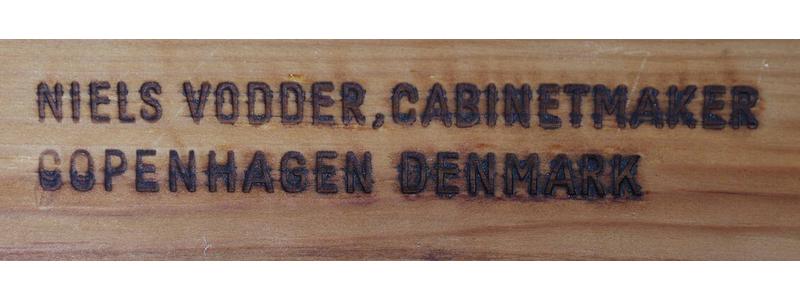
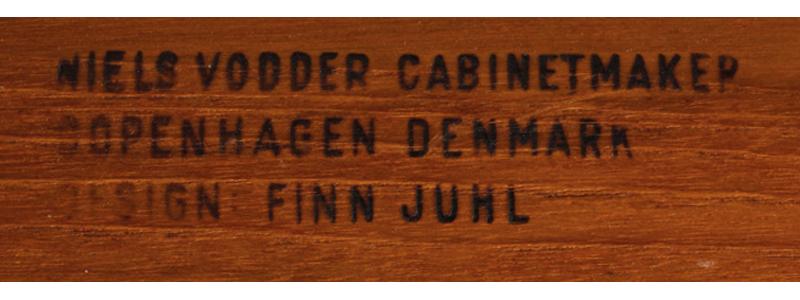
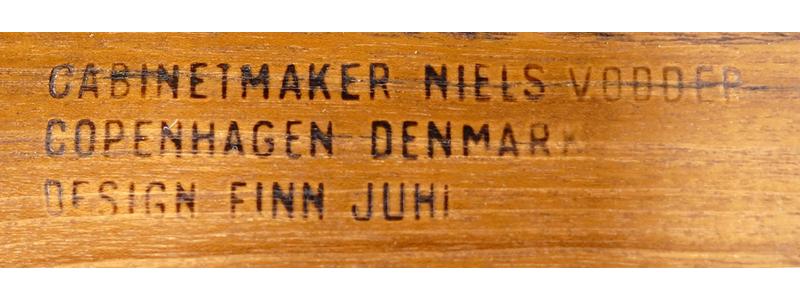
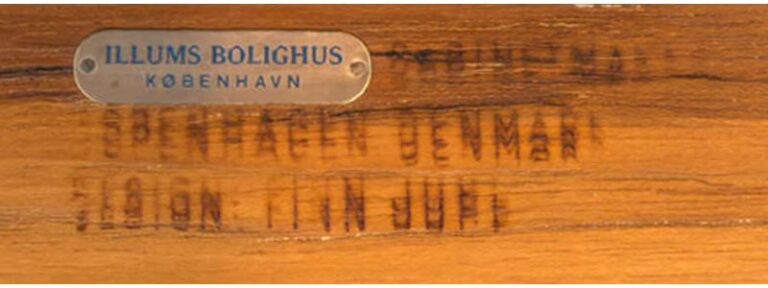
Documented Finn Juhl furniture executed by Niels Vodder can carry branded or impressed marks such as “CABINETMAKER NIELS VODDER / COPENHAGEN DENMARK / DESIGN FINN JUHL.” Wording and punctuation vary between examples, and not every piece carries the same format. Some pieces also retain retailer labels, including metal labels from Illums Bolighus. Marks should be assessed together with model, construction, materials and provenance rather than used alone to establish authenticity or an exact production date.
References
House of Finn Juhl — Timeline
House of Finn Juhl — About Finn Juhl
Designmuseum Danmark — Director’s Choice
Grete Jalk (ed.), 40 Years of Danish Furniture Design
Bruun Rasmussen — Niels Vodder catalogue references and documented works
Phillips — documented Niels Vodder maker’s marks on Finn Juhl furniture