

The Point of Departure as a Designer
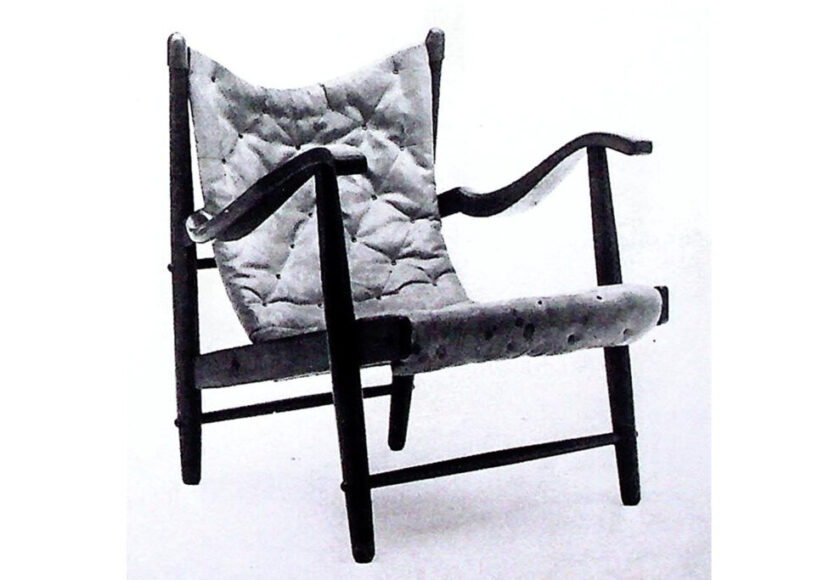
In 1938, at the age of just twenty-four, Hans J. Wegner made his official debut as a furniture designer at the Copenhagen Cabinetmakers’ Guild Exhibition. The chair he presented on this occasion was designed for the cabinetmaker Ove Lander and is today known as the First Chair.
Crafted in natural oak and mahogany, the chair featured a flowing arm profile and a structure that was deliberately left visible. The gentle curves extending from the backrest into the arms respect the inherent properties of the wood and appear to respond intuitively to the movements of the hand and the human body. Even at this early stage, the sculptural vocabulary that would later define masterpieces such as The Chair and the Wishbone Chair was already clearly present.
Reception at the Exhibition and the Origins of a “Phantom Chair”
At the time of the exhibition, the First Chair was highly praised by jurors and critics alike. Despite this acclaim, it was never put into commercial production and remained a prototype created solely for exhibition purposes. It is said that Ove Lander gifted one of the few examples made for the show to his daughter as a wedding present. The chair never entered the market, and over time it came to be known as a “phantom chair.”
Rather than a product intended for commercial success, it was a pure experimental work—an attempt by a young designer and an experienced craftsman to give form to an ideal. In this sense, the First Chair reflects the spirit of Danish modernism in the 1930s, when exhibitions served as laboratories for new ideas and design education, rather than platforms for mass production.
The Beginning of a Design Philosophy That “Shows” Structure
The most significant aspect of the First Chair lies in its treatment of structure as an integral part of the design. Instead of concealing joints and reinforcements, Wegner chose to reveal them, allowing the strength and tension of the wood to become part of the visual expression.
The stretchers piercing the legs and the arms flowing outward are emblematic of a union between structural logic and craftsmanship. This approach marks the beginning of what would later be described as Wegner’s concept of organic functionality: the belief that form must arise naturally from structure and function, guided by the relationship between furniture and the human body. Even at this early stage, Wegner had already identified “structural honesty” as a central theme in his work.
Education and Influences: Kaare Klint and the Memory of a Chinese Chair
At the time, Wegner was studying at the Furniture School of the Royal Danish Academy of Fine Arts, where he was deeply influenced by the teachings of Kaare Klint. Based at what is now Designmuseum Danmark, this education emphasized measured drawings and functional analysis of historical furniture, promoting a rational design approach grounded in tradition.
A particularly decisive influence was a Chinese chair from around 1800 that entered the museum’s collection in 1937. Its construction—assembled without nails or glue—and the elegant outward-curving top rail left a lasting impression on Wegner. These elements can be traced directly to the arm and back profiles of the First Chair, and later to works such as the Chinese Chair and ultimately The Chair itself.
The Significance of the Reconstruction: Rediscovering the Origins of Danish Design
In the current exhibition, the long-lost First Chair has been reconstructed at full scale. With only limited original documentation surviving, the project relied on a small number of sketches and photographs to faithfully recreate the original design intent.
This undertaking is more than a simple reproduction. It represents an effort to bring the origins of Danish modern design back into the present and has been widely recognized as such. By revisiting this early work, we gain a clearer understanding of the foundations upon which Wegner later built his international reputation.
Understanding the Origin to See the Future
The First Chair is not a fully resolved masterpiece, but rather a symbol of beginnings. It embodies a sincere engagement with materials, an uncompromising honesty toward structure, and a determination to unite beauty and function.
The reconstruction is not an exercise in nostalgia, but an opportunity to reconsider what design truly means. Through this single chair, the curiosity of a young Wegner—shaping form through dialogue with wood, guided by respect for craft—continues to speak to us with remarkable clarity today.