

A Turning Point in Danish Modern Design
From the late 1930s to the early 1940s, Danish modern design entered a decisive period of transformation. Furniture was no longer conceived solely as crafted objects for private homes, but increasingly as an integral part of shared environments used by many people. One of the most emblematic stages for this shift was Aarhus City Hall, designed by Arne Jacobsen and Erik Møller.
Within this monumental public building, Hans J. Wegner—still in his mid-twenties—was entrusted with the design of all interior furniture. His challenge extended far beyond furnishing the mayor’s office or ceremonial rooms. He was tasked with creating a functional and humane working environment for hundreds of municipal employees, addressing daily use, durability, and spatial coherence on an unprecedented scale.
Integrating Architecture and Furniture
Aarhus City Hall was conceived as a Gesamtkunstwerk, a total work of art in which architecture, interior finishes, and furniture were inseparable. Bog oak flooring, brass details, and custom-designed furnishings created an interior that balanced architectural rigor with material warmth.
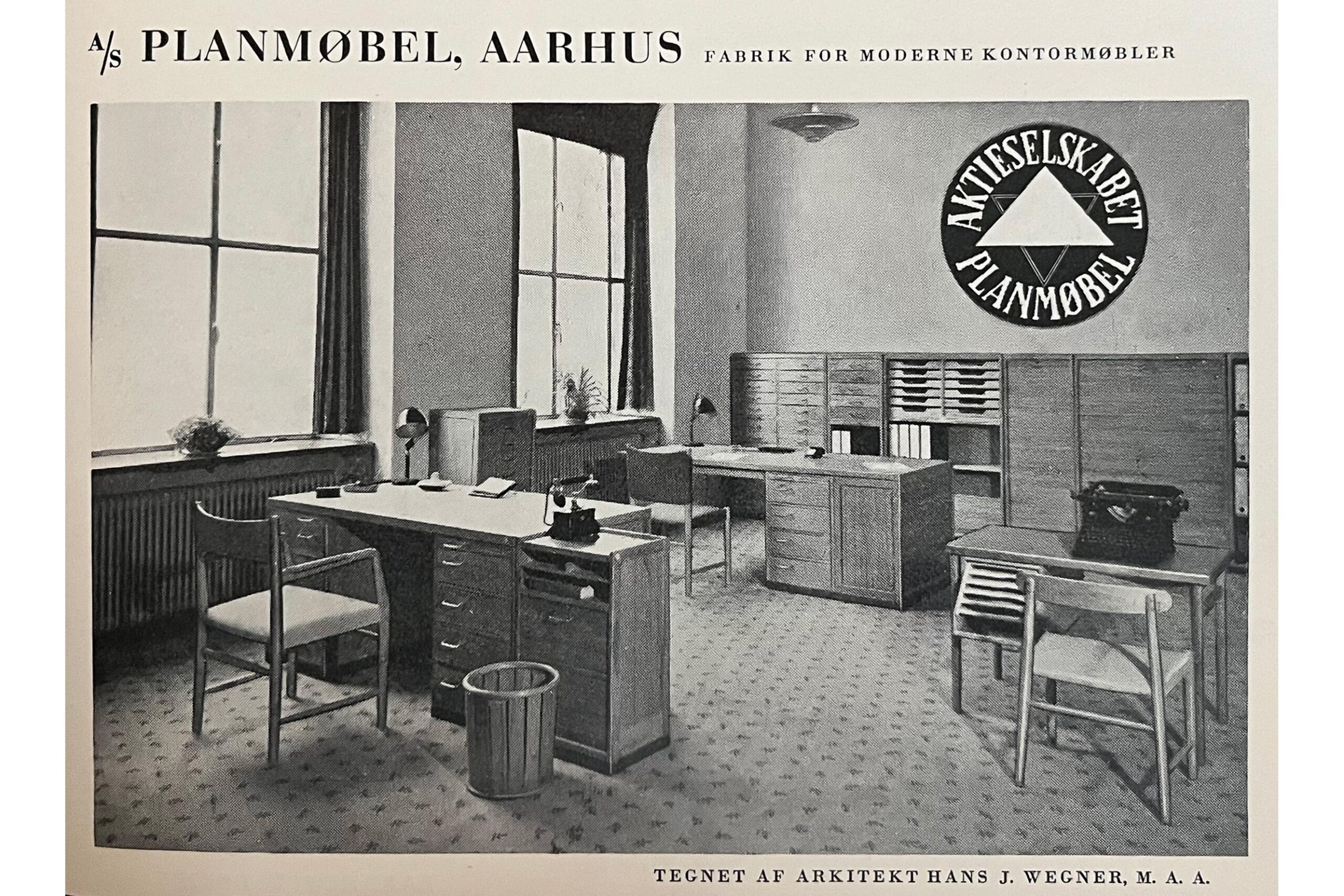
Within this context, Wegner approached furniture not as isolated objects but as a system that supported the building’s architectural logic. Essential to realizing this vision was the Aarhus-based manufacturer Planmøbler. Combining advanced woodworking skills with the capacity for consistent large-scale production, Planmøbler was uniquely positioned to supply substantial quantities of furniture without compromising quality.
Modular Office Furniture Developed with Planmøbler
Together, Wegner and Planmøbler developed a modular system of office furniture specifically for Aarhus City Hall. Desks, cabinets, and chairs were designed as independent elements, yet unified through consistent materials, dimensions, and structural principles, allowing them to function as a coherent whole.
The desks balanced solidity with practicality, offering drawer configurations adaptable to different administrative needs. Storage units featured tambour doors, enabling efficient document handling even in confined spaces. These solutions anticipate what would later become known as system office furniture, marking Wegner’s first sustained engagement with furniture designed explicitly for public administration.
Early Signs of Organic Functionalism in Seating Design
Among the most significant outcomes of this project was the armchair later known as the Aarhus City Hall Chair. Its continuous solid-wood curve flowing from backrest to armrests was not merely an aesthetic gesture, but a response to ergonomic demands for prolonged seating.
Simpler chair variants were developed for waiting areas and communal spaces, representing early experiments that would later inform Wegner’s mass-produced designs. These chairs reveal the emergence of Wegner’s distinctive approach to organic functionalism—eschewing ornament while placing the human body at the center of design considerations.
From Planmøbler to Wegner’s Later Work
Through his collaboration with Planmøbler, Wegner established a clear position between traditional craftsmanship and industrial production. This experience informed his later work with manufacturers such as PP Møbler and Getama, where similar principles were refined and expanded.
The furniture created for Aarhus City Hall may appear understated, yet it is rich in material sensitivity and structural clarity. In a rigid governmental setting, these designs introduced a sense of human scale and warmth. The collaboration between Wegner and Planmøbler thus marks a decisive moment when Danish modern design entered the realm of public space—an influence that continues to resonate in contemporary office and environmental design.