

A Structural Analysis Through Material Engineering, Design Philosophy, and Asset Value
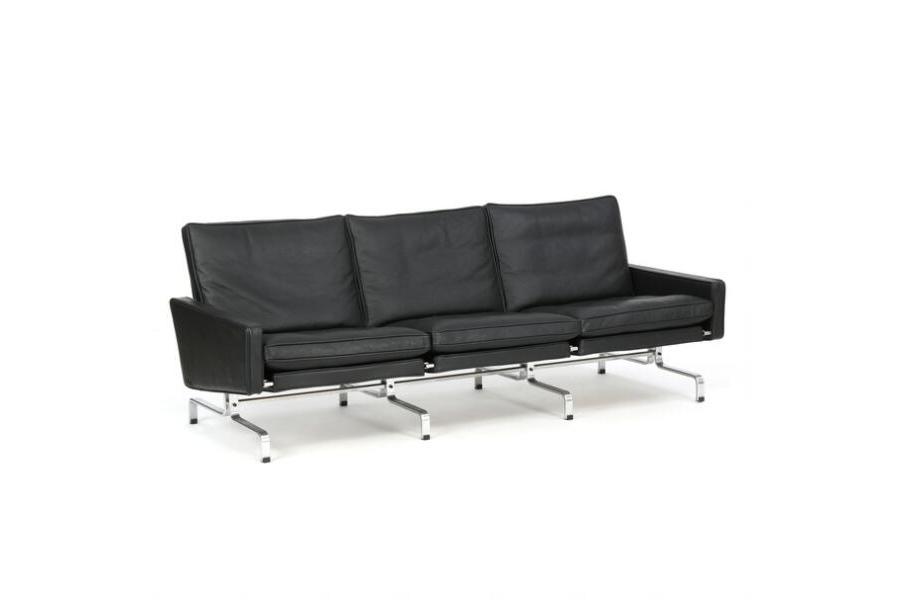
The PK31/3 sofa, designed by Poul Kjærholm and produced by Fritz Hansen, occupies a singular position in the landscape of modern furniture.
With a retail price in Japan exceeding ¥7,000,000, it cannot be adequately described as a “luxury sofa.” Its value is the result of a layered structure—technical, philosophical, historical, and economic.
This article reorganizes the logic behind the PK31/3’s price for an international readership, examining how materials, manufacturing processes, and long-term valuation converge into a coherent whole.
Kjærholm’s Design Philosophy: Furniture as Structure
Introduced in 1958, the PK31 series reflects Kjærholm’s conviction that furniture should be understood not as decoration, but as a structural object. His goal was not visual richness, but absolute clarity of proportion and construction.
The one-seater is based on a near-perfect cubic geometry. When expanded into a three-seater, this order is not diluted. Instead of simply elongating the form, Kjærholm designed the sofa as a sequence of independent modules. From the rear, the outline of each seat remains legible, preserving architectural rhythm even at larger scale.
Such rigor demands extensive calculation and prototyping at the design stage. These invisible efforts—long before manufacturing begins—are an essential but often overlooked component of the PK31/3’s cost.
Spring Steel Instead of Stainless: Metallurgical Complexity
The frame of the PK31/3 is made not from standard stainless steel, but from matte-chromed spring steel. This choice is central to both its appearance and performance.
Spring steel combines high yield strength with elasticity, allowing the frame to remain visually slender while safely supporting significant loads. When seated, the frame offers a subtle, controlled flex that works in concert with the cushions to create a unique sense of comfort.
However, this material is exceptionally demanding to work with. Forming, welding, and finishing require advanced metalworking expertise. The matte chrome finish itself involves multiple stages of polishing and electrochemical treatment, with low yield rates that directly elevate production costs.
Aniline Leather: The Rarity of the Top Five Percent
The upholstery used for the PK31/3 belongs to the highest category of aniline leather. Because the surface is not coated with pigment, only hides free from scars, insect marks, or visible veins can be used.
Industry estimates suggest that less than five percent of global raw hides meet these criteria. This immediately places the material in a scarce category.
Beyond rarity, aniline leather offers high breathability and natural thermal response, remaining comfortable over long periods of use. Over time, its color deepens and develops a rich patina. Value is not fixed at the moment of purchase, but accumulates through use—an idea perfectly aligned with Kjærholm’s respect for materials as living elements.
Hand Stitching and Adhesive-Free Construction
The PK31/3 is manufactured through processes fundamentally different from those of mass-produced sofas. Adhesives are minimized, and the leather is finished largely through hand stitching.
Each stitch requires precise tension control, resulting in a substantial number of labor hours for a single three-seater. This method preserves the leather’s natural flexibility and, crucially, allows for future reupholstery and repair.
The sofa is designed for decades of use, not short-term consumption. The initial price reflects this long temporal horizon.
Modular System and Industrial Precision
The PK31 system extends seamlessly from one- to four-seater configurations. In the three-seater version, the frame spans nearly two meters while maintaining strict horizontal stability.
Achieving this requires joint tolerances controlled at sub-millimeter levels. Assembly demands exceptional industrial precision, ensuring that the sofa retains both structural integrity and visual clarity over time. These qualities may go unnoticed in daily use, but they are fundamental to long-term durability and appearance.
Asset Value and Market Stability
Despite its high entry price, the PK31/3 exhibits unusually slow value depreciation. Early examples produced by E. Kold Christensen prior to 1982 are often valued at levels comparable to, or even exceeding, current production models.
This stability reduces the effective cost of ownership and positions the PK31/3 closer to a long-term asset than a consumable product. Its market behavior reinforces the notion that the sofa operates within a different economic category altogether.
What Does One Invest in When Buying a PK31/3?
The price of the PK31/3 is structurally composed of:
- Highly complex spring steel processing
- Aniline leather drawn from less than five percent of available hides
- Labor-intensive, adhesive-free hand craftsmanship
- A design philosophy and market reputation sustained for over half a century
Purchasing a PK31/3 is not simply acquiring a sofa. It is a decision to live with— and preserve—one of the clearest culminations of twentieth-century modern design.
The price is undeniably high, but it quietly and consistently reflects a system without compromise: in design, in materials, in manufacturing, and in the way value is allowed to accumulate over time.