
A Form of Friendship Born in Wartime
In 1944, during the hardships of the Second World War, material shortages were a daily reality in Denmark. It was in this constrained environment that Hans J. Wegner designed a small set of furniture. The project was not conceived for the market, nor intended for mass production. It emerged from a deeply personal motivation.
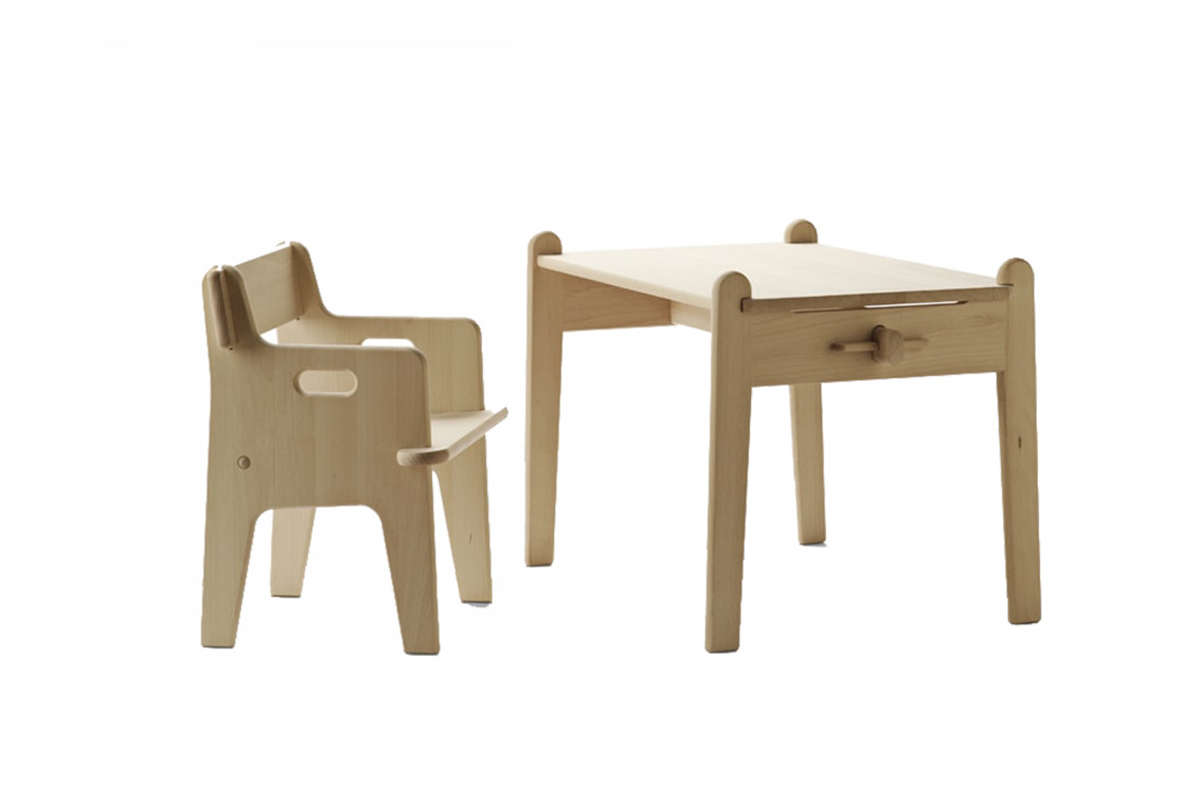
The Peters Table (CH411) and Chair (CH410) were created as a gift for the newborn son of Børge Mogensen, Wegner’s close friend and a fellow designer of the same generation. In a time marked by scarcity, the act of designing and making something by hand for a friend’s family became the starting point of this furniture. That personal gesture is inseparable from the identity of the Peters set.
A Design Attitude Shaped by Friendship
Wegner and Mogensen were both central figures in the formation of Danish Modern design. Rather than rivals, they were friends who shared fundamental values: practicality, structural honesty, and a deep connection between furniture and everyday life. These shared convictions shaped the way Wegner approached the Peters set.
Although conceived as a personal gift, the Peters Table and Chair resonate with Mogensen’s belief in furniture made for real living. The result is a design that feels intimate yet universal, rooted in friendship but capable of speaking to a much wider audience.
Furniture Designed Specifically for Children
The Peters set is not a reduced version of adult furniture. Its proportions, softly rounded edges, and stable contact with the floor reflect careful observation of children’s bodies and movements. Safety is treated as a given, not as a limitation, and aesthetic clarity emerges naturally from that premise.
Here, children’s furniture is not simplified or compromised. Instead, the same level of design integrity found in Wegner’s adult furniture is applied with equal seriousness, adapted thoughtfully to its young users.
The Invention of Tool-Free Assembly
Both the Peters Table and Chair are composed of a small number of solid wood components that can be assembled without nails, screws, or glue. While this approach anticipates what would later become known as flat-pack furniture, its origin lies not in industrial efficiency but in craftsmanship and structural precision.
The act of assembly itself becomes an experience. The furniture functions almost like a three-dimensional puzzle, inviting interaction, curiosity, and understanding of how form and structure come together.
Universality Born from Constraint
For Wegner, wartime limitations did not suppress creativity. On the contrary, restricted materials, simplified forms, and the need for reproducibility led to a design of remarkable clarity and durability. The Peters set ultimately achieved a universality that transcends its historical moment.
After the war, the furniture was produced by FDB, and its continued production today confirms that it was never a temporary solution. What began as a response to necessity became a lasting design.
A Key to Understanding Wegner’s Design Philosophy
Compared to iconic works such as the Round Chair or the Wishbone Chair, the Peters Table and Chair possess a quieter presence. Yet within this modest scale lies the essence of Wegner’s philosophy: respect for materials, honesty of structure, and design rooted in human use.
Equally important is the human story behind the object. The friendship between Wegner and Mogensen lends warmth to the design, reminding us that furniture can connect function with human relationships. Through this small set, we are invited to reconsider how Wegner united practicality with empathy, and design with life itself.