

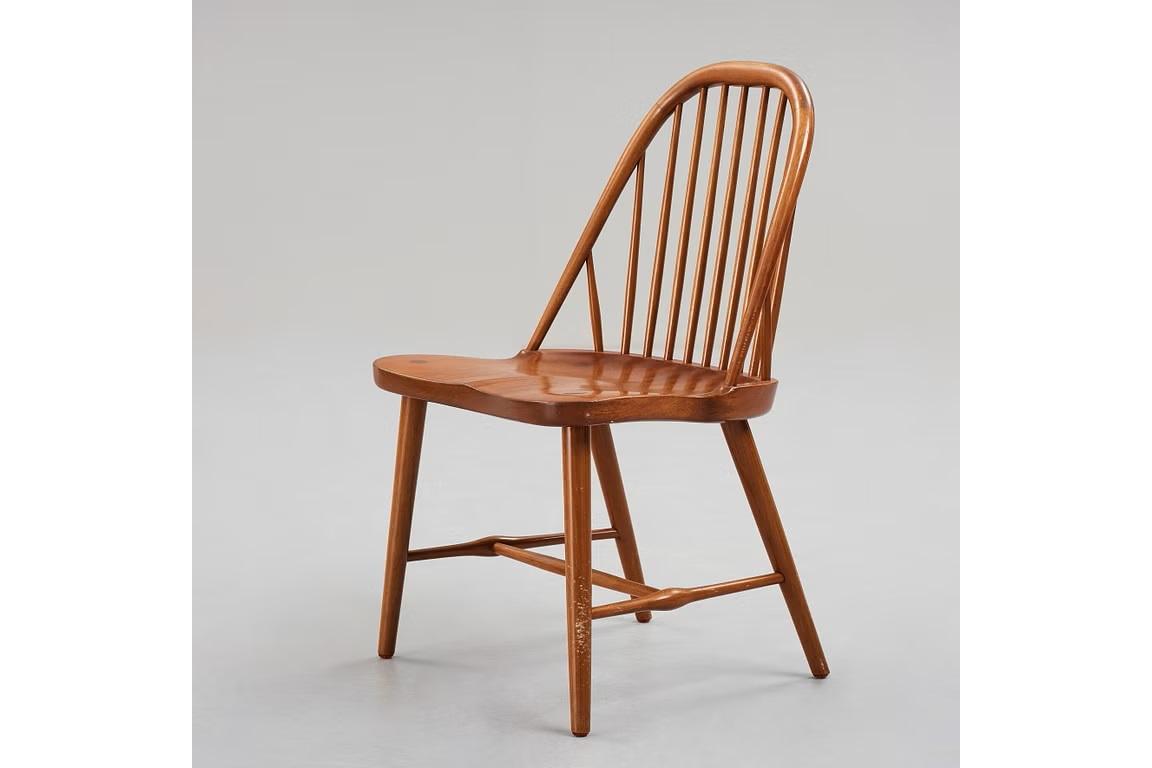
Furniture for Aarhus City Hall and Nyborg Public Library
How the Young Hans J. Wegner Learned to Collaborate with Architecture
A Turning Point Through Architectural Collaboration
In the late 1930s, Hans J. Wegner was studying at the School of Arts and Crafts in Copenhagen when his exceptional talent was recognized by Orla Mølgaard-Nielsen. Through Nielsen’s recommendation, Wegner was introduced to architects Arne Jacobsen and Erik Møller, who were engaged in the design of Aarhus City Hall. This encounter marked a decisive turning point in Wegner’s early career, placing him within an architectural environment where furniture and space were conceived as inseparable.
At the time, Wegner was in his early twenties and had not completed a formal architectural education. Nevertheless, his sensitivity to materials, structure, and proportion earned the trust of leading figures in Danish architecture. Working within the studio of Jacobsen and Møller, he encountered a design approach in which furniture was understood not as an independent object but as an element that responds directly to architectural scale and function.
Furniture for Nyborg Public Library (1939)
One of Wegner’s first major furniture projects in this context was the complete furnishing of Nyborg Public Library, designed by Erik Møller in collaboration with Flemming Lassen. Between 1938 and 1939, Wegner was responsible for designing all of the library’s furniture. Rather than treating each piece as an isolated object, he developed a coherent furniture system appropriate for a public cultural institution.
The resulting furniture combined rational construction with a restrained warmth, supporting the library’s role as a shared civic space. Functional clarity was carefully balanced with tactile qualities, allowing the furniture to accommodate prolonged use while maintaining a calm architectural presence.
During his final period at the School of Arts and Crafts, Wegner undertook a detailed study of eighteenth-century Windsor chairs at what is now the Danish Museum of Art & Design. This close examination of traditional wooden chair construction informed his use of spindle-backed forms in the library furniture. Through the analysis of historical structures, Wegner began to articulate a central concern that would define his later work: redefining the relationship between the human body and material through structurally honest design.
Experience at Aarhus City Hall (1940–1942)
From 1939 to 1942, Wegner continued his collaboration with Jacobsen and Møller, assuming responsibility for the furniture design of Aarhus City Hall. The scope of this project was extensive, encompassing both representative spaces such as council chambers and the everyday working environments of municipal employees.
Within these designs, one can already observe the structural clarity and controlled tension that would later characterize Wegner’s mature furniture. Furniture was developed in direct response to architectural scale, circulation, and spatial rhythm, reinforcing the idea that furniture functions as an extension of architecture rather than as an autonomous element.
Reflecting on this period, Wegner later recalled that he designed all of the furniture for the city hall while maintaining close dialogue with Erik Møller as the responsible architect. Working within a small and closely coordinated team allowed furniture and architecture to evolve in parallel, ensuring that spatial intention and structural logic informed one another directly. It was in this collaborative environment that Wegner’s enduring conception of furniture as an integral component of architectural space took shape.
Planmøbler and the Path Toward Independence
Around 1941, the furniture manufacturer Planmøbler, which had produced part of the furniture for Aarhus City Hall, took notice of Wegner’s designs. For the company, Wegner developed a series of office furniture that marked his first sustained engagement with industrial production. Desks, cabinets, and shelving units were conceived as part of a modular system in which dimensions were carefully coordinated across different furniture types.
This systematic approach reflects the influence of Kaare Klint, Wegner’s former teacher, whose methodology emphasized furniture design based on human scale and functional necessity. Through his work with Planmøbler, Wegner gained confidence in his ability to operate independently as a furniture designer while maintaining a close dialogue with architectural principles.
Toward a Danish Furniture Legacy
During this same period, Wegner’s personal life also entered a new phase. He met Inga Helbo, a secretary at the architectural studio, and the two married in 1940. This stability coincided with a decisive acceleration in his professional development. Mølgaard-Nielsen soon introduced Wegner to the master cabinetmaker Johannes Hansen, leading to their first collaborative presentation at the Cabinetmakers’ Guild Exhibition in 1941.
This exhibition marked the beginning of a partnership that would last for twenty-six years and become one of the most significant collaborations in Danish furniture history. Early works from this period already incorporate structural ideas developed at Aarhus City Hall and within the Planmøbler projects, including articulated arm structures and cross-frame elements. These experiments contributed to a gradual reduction of visual weight and an increasing emphasis on structural clarity.
Structural Honesty and Architectural Thinking
At the core of Wegner’s early work lies a commitment to structural honesty. Rather than concealing construction, his designs clearly express what supports and what is supported. This principle parallels architectural ideas of structural transparency and reflects Wegner’s belief that furniture functions as a form of small-scale architecture.
The years spent working in Aarhus were therefore not merely formative but decisive. Through close collaboration with architects and manufacturers, Wegner established a lifelong dialogue between furniture, architectural space, and human use—one that would define his contribution to modern design.