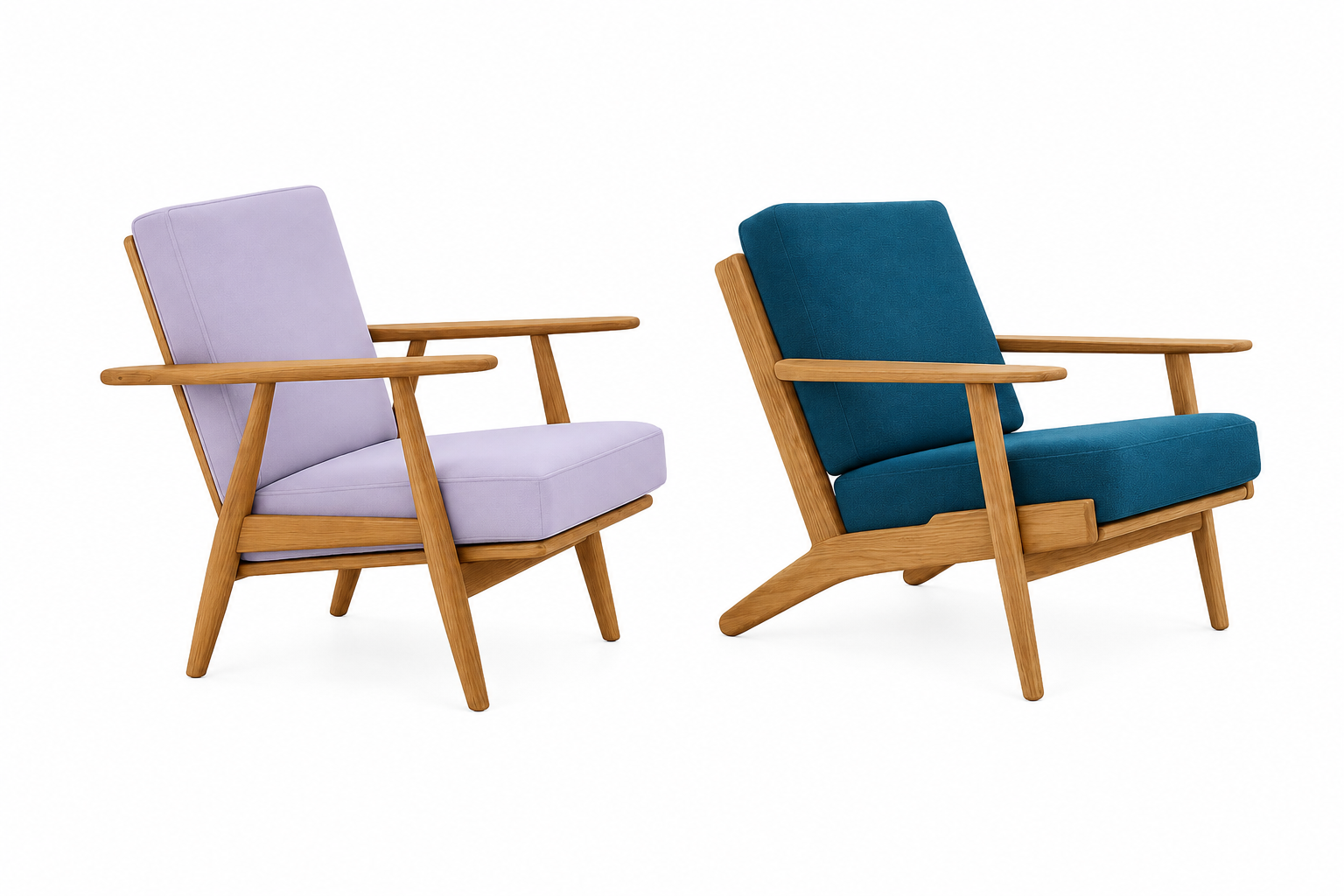
GE290 and GE240 are both representative easy chairs designed by Hans J. Wegner for GETAMA, yet their underlying structural ideas are markedly different. The distinction is not merely stylistic: each chair proposes a different way of supporting the body.


The defining feature of the GE290 is the continuity between the seat frame and the rear legs. The rear legs extend diagonally from the frame supporting the seat and establish the angle of the backrest. This makes the chair read as a single large structural skeleton and gives it a strong sense of stability. Seen from the side, the frame sweeping far toward the rear has an almost architectural character.
The GE290’s arms are equally distinctive. Thick, flat sections of solid wood are set horizontally to the floor. They function not only as armrests but almost like small shelves on which a book or cup can be placed. These slab-like arms are a key part of the GE290’s architectural presence.
This structure also gives the GE290 a notably reclined posture. The body is naturally encouraged backward, creating a sensation closer to settling into the chair than simply sitting upright. Its character is particularly suited to quiet rest, reading, or listening to music for extended periods.


GE240, by contrast, was conceived from a rather different idea. It is often called the “Cigar Chair,” a nickname associated with the form of its arms. Fuller at the center and tapering toward the ends, they describe a soft curve reminiscent of a cigar. In contrast to the GE290’s board-like arms, the GE240’s armrests are organic forms that sit naturally beneath the hand.
The structural arrangement is also different. Rather than integrating the seat and rear legs as the GE290 does, the GE240 is organized as a four-legged chair in which the front legs, rear legs, and seat frame read as distinct elements. This creates more open space around the frame and less visual weight than the GE290, giving the chair a lighter and softer presence.
That structural difference also affects the sitting experience. The GE240 is less deeply reclined than the GE290 and its seat feels comparatively upright. Because the center of gravity is not drawn as far backward, getting in and out is easier. If the GE290 suggests “static rest,” the GE240 has a stronger character as a chair for everyday life, including conversation and frequent movement.

The GE290 can be understood as a chair conceived as a structural body, while the GE240 can be read as a chair composed through lines. The GE290 has architectural strength; the GE240 has a sculptural quality shaped through carved wood. Comparing these two GETAMA models makes especially clear how Wegner pursued comfort through distinctly different approaches.