

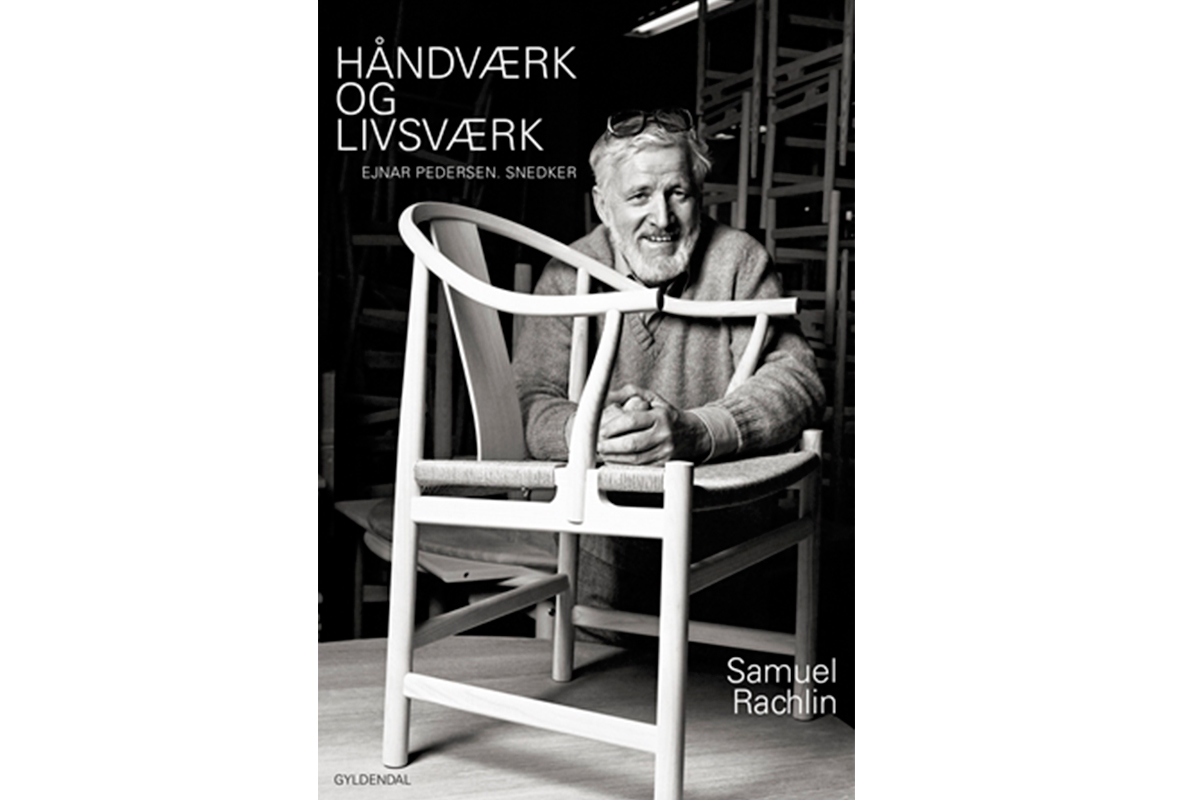
This book is a memoir reflecting on the ninety-year life and professional journey of master cabinetmaker Ejnar Pedersen. It explores how he blended craftsmanship and creativity, achieving a profound sense of fulfillment through what he describes as his “life’s work.”
Pedersen referred to himself as “a fortunate craftsman and a privileged cabinetmaker,” having had the rare opportunity to collaborate closely with leading figures of Denmark’s golden age of furniture design—Hans J. Wegner, Poul Kjærholm, Finn Juhl, Arne Jacobsen, among many others. Their collaborations were built on a powerful symbiosis: designers brought ideas and creative vision, while craftsmen like Pedersen translated them into physical form with extraordinary skill. His partnership with Poul Kjærholm was especially close; through intense dialogue and repeated testing, they developed a shared working method grounded in mutual respect and curiosity. Pedersen valued Kjærholm’s belief that architects should understand the making process and observe how craftsmen work in the workshop. Designers such as Wegner visited the workshop daily, spending hours developing prototypes side by side with the craftsmen. This “dense atmosphere” of collaboration—as Pedersen describes it—was akin to the relationship between musicians and a conductor. Both craftsman and designer experienced a special satisfaction: the craftsman through contribution, and the designer through watching ideas come to life.
For Pedersen, craftsmanship was never just a technical skill; it was “the mind, the hand, and the eye.” His passion for making furniture beautiful, functional, and comfortable was the driving force behind his work. He was deeply interested in learning new techniques and discovering new approaches to working with wood. He believed that openness to experimentation and innovation was essential for staying “young” as a craftsman. He often contrasted genuine craftsmanship—which he believed carries a “spirit” that can endure for generations—with mass-produced furniture, which he dismissed harshly as “garbage.”
Establishing and running his own workshop, PP Møbler, was far from easy. He faced dissolved partnerships, financial crises, and constant uncertainty. Pedersen admitted that he was not naturally skilled in business, joking that banks and creditors often felt like his real partners. Yet his passion for the work—and what he called moments of “light”—kept the workshop alive through these hardships. Overcoming each challenge deepened his sense of purpose, bringing meaning and fulfillment both to his work and to his life. Pedersen feared, however, that his profession was “endangered,” citing the shift from traditional apprenticeship training to technical schooling as a threat to the transmission of craft knowledge. True knowledge, he believed, is passed down in the workshop—through tradition, practice, and direct mentorship—not in classrooms. This conviction motivated his efforts to establish a school for craftsmen and to advocate for a furniture museum dedicated to preserving Denmark’s design heritage.
The values Pedersen built into his workshop—community spirit, openness to experimentation, and uncompromising quality—have been passed on to his son Søren and grandson Kasper. His “life’s work” continues to live through the next generations, illustrating how craftsmanship and creativity shaped not only his career but his entire way of life.
Master cabinetmaker Ejnar Pedersen is one of the defining figures of Danish furniture craft. As co-founder and master craftsman of PP Møbler, he collaborated with many of Denmark’s most influential designers—including Hans J. Wegner, Poul Kjærholm, Finn Juhl, and Nanna Ditzel—who helped establish the global reputation of Danish design.
In conversations with Samuel Rachlin, Pedersen recounts his childhood in Vejen, his apprenticeship and early professional years, and his eventual establishment of PP Møbler in Allerød. The stories reveal the tensions and contradictions that existed between designers, architects, and manufacturers—and how close collaboration, experimentation, and the interplay between aesthetics and craftsmanship were essential to the development of Denmark’s most iconic furniture.
Pedersen lived a full and rich life—not only as a craftsman, but also as a father, husband, and partner. He speaks of his marriage to Kirsten, with whom he had two children, Karen and Søren, and the tragedy of her early passing. Later, he spent 28 years with Hanne Kjærholm, sharing both a personal and professional worldview.
More than a personal memoir, the book serves as a testament to the history of Danish woodworking, the cultural tradition that underpins its world-renowned craftsmanship, and the essential role of the workshop in preserving this heritage.
(Adapted from Gyldendal)
About
Author
Samuel Rachlin
Publisher
Gyldendal
Size
244 pages
Content
- The Road to Allerød
- The First Years
- Apprenticeship
- Working Between Copenhagen and the Workshop
- The Name “PP”
- Between Designer and Craftsman
- Wegner and the Furniture
- PK
- Work and Private Life
- Hardships and Change
- Connections with Japan
- People and Furniture
- Eyes, Hands, Spirit—and an Endangered Craft
- The Queen and the Machines
- Sixty Years of PP History
- Good Craftsmanship
- Hard-Earned Wisdom
- The Formal Chair
Furniture
・The Golden Chair — The official state chair used at Danish ceremonial events, including Christiansborg Palace. Pedersen criticizes it sharply as uncomfortable and unbecoming of a design nation. A competition was held to replace it, but most proposals were rejected, and the winning design proved technically problematic.
・Kaminestolen (Fireplace Chair) — Sold under the Vodder name but produced in collaboration among PP Møbler and others, with upholstery by Ivan Schlechter. Pedersen recounts giving Vodder the molds, only to burn them later after payment was never received.
・Ghost — An experimental bent-veneer chair designed by sculptor André Bloc for an exhibition with Nanna and Jørgen Ditzel. The unbent form resembled a ghost, giving the piece its name. It uses the same molding principle as Arne Jacobsen’s Ant Chair.
・Ant Chair — Designed by Arne Jacobsen and later produced by Fritz Hansen. A landmark piece of molded plywood furniture, sharing technical lineage with the Ghost chair.
・PK54 — A dining table by Poul Kjærholm featuring a marble or granite top encircled by a maple ring. PP Møbler produced the ring, supplying it to E. Kold Christensen and later to Fritz Hansen. Pedersen recounts personally making a ring for Kjærholm’s widow, Hanne.
・Louisiana Concert Hall Chair — Designed by Poul Kjærholm and produced with PP Møbler for the Louisiana Museum’s concert hall. Early failures in maple-wood chipping required Pedersen himself to re-weave parts in ash.
・Fan Chair — Designed by Nanna Ditzel, inspired by Caribbean decorative forms. The concept later evolved into the Trinidad Chair.
・Trinidad Chair — Ditzel’s celebrated design, produced by Fredericia Furniture with metal legs. Pedersen suggested a wooden-leg version to strengthen the design concept.
・Chieftain Chair — Finn Juhl’s masterwork, referenced in captions describing collaborations between PP Møbler and upholsterer Ivan Schlechter.
・Official State Chair Competition Winner — Designed by Nikolai de Gier and Christoffer Harlang, though found technically unsuitable and never fully realized.
・Bamse Chair — Designed by Hans J. Wegner and produced by AP Stolen. PP Møbler contributed frame work for this important piece.
・Wanscher Chair — Produced by a highly skilled but unnamed craftsman, distinguished by its cross-shaped back legs and cane-work detailing.
・Wegner Chair Produced by Fritz Hansen and PP Møbler — A rotating office chair with a large headrest; PP introduced semi-automatic lathes to produce it efficiently.
・45 Chair — Finn Juhl’s iconic lounge chair, which Pedersen was asked to produce by Hansen & Sørensen but declined.
・An Unfinished Chair Based on the Louisiana Chair — A final project discussed between Kjærholm and Pedersen, left incomplete at the time of Kjærholm’s death.
・Mogens Koch Chair Frames — Upholsterer Ivan Schlechter asked Pedersen to produce mahogany frames for a series designed by Mogens Koch, including a two-seater sofa, a small chair, and a large wing chair that later became famous.
・Wegner’s Office Chair — A swivel chair with a wide headrest, referenced in workshop production notes.
・Wegner Chair Produced by Johannes Hansen — Used by the Danish Royal Family, referenced through photographic captions.
Review
HÅNDVÆRK OG LIVSVÆRK is the memoir of Ejnar Pedersen, master cabinetmaker and co-founder of PP Møbler, who played a central role in producing some of Denmark’s most iconic furniture. His own words bring to life his collaborations with Hans J. Wegner, Poul Kjærholm, Finn Juhl, and other world-renowned designers.
Beyond the celebrated history of design, the book reveals a craftsman’s perspective—his devotion to quality, his worries about the decline of traditional apprenticeship, and his belief in the workshop as the true home of knowledge. Pedersen’s reflections offer a rare, intimate look into the “small universe” of the craft workshop, where hands, tools, and ideas come together to shape enduring works of design.
This is more than a record of furniture-making; it is the life story of a man who faced hardship, loss, and financial strain, yet never abandoned his dedication to honest craftsmanship. It is essential reading not only for lovers of Danish design, but for anyone drawn to the pursuit of authenticity, meaning, and lifelong mastery.