

The Formation of an Early Career and the Realization of a Gesamtkunstwerk
Architectural Background of Aarhus City Hall
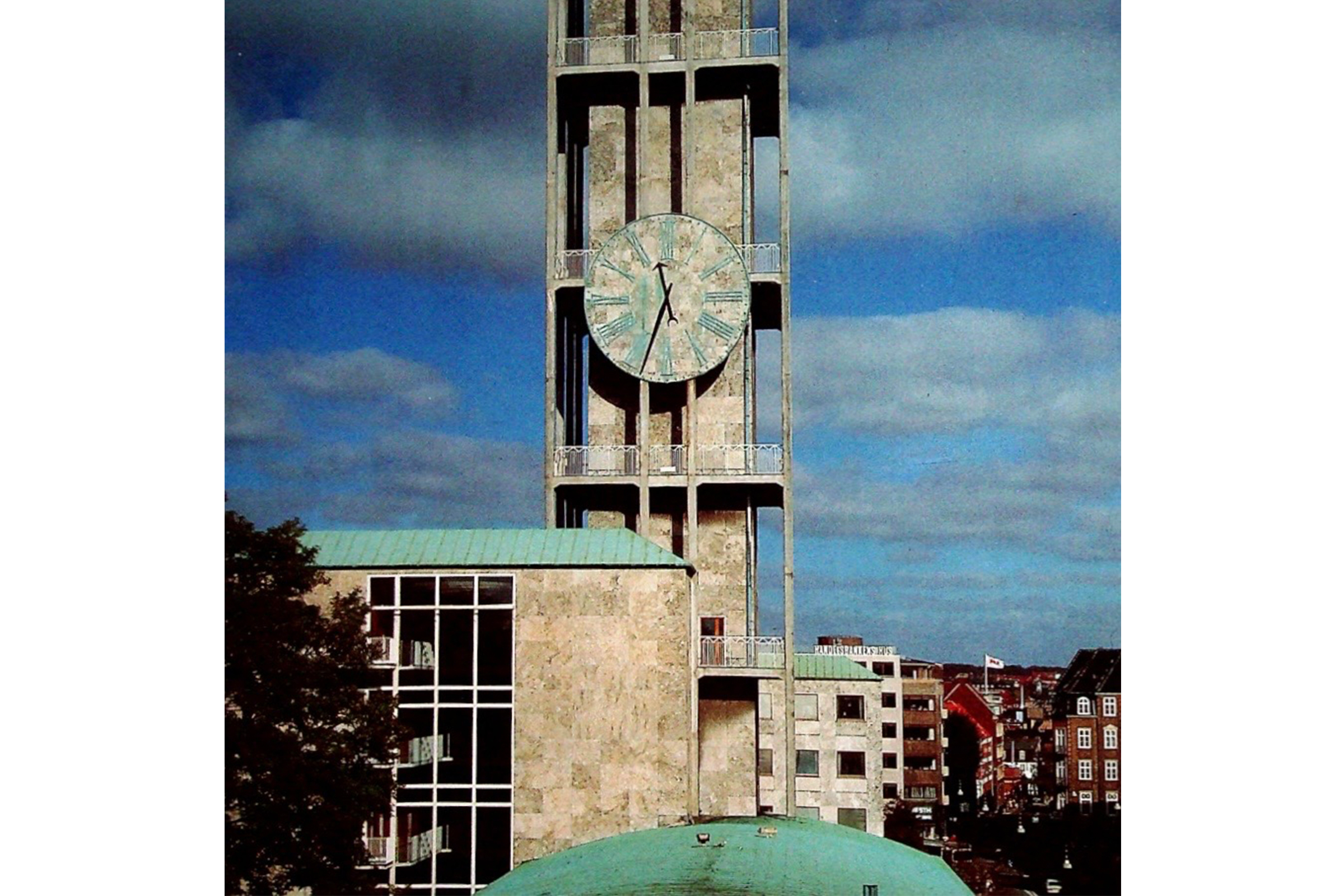
Aarhus City Hall, designed by Arne Jacobsen in collaboration with Erik Møller and completed in 1942, stands as one of the most significant monuments of Danish Functionalist architecture.
The building is characterized by a rational, linear composition, yet it is distinguished by a refined sensitivity to materiality and spatial balance. Its exterior, clad in Norwegian marble, conveys a sense of order and quiet dignity, while the overall architectural composition—including the iconic tower—has secured its place as a landmark in the history of modern Danish architecture.
The Participation of a Young Hans J. Wegner
Hans J. Wegner’s involvement in this project marked a decisive turning point in his early career.
In 1938, at just twenty-four years of age, Wegner was invited to join Jacobsen’s architectural office and relocated to Aarhus. At the time, he possessed a rare combination of hands-on cabinetmaking experience and theoretical training acquired at the School of Arts and Crafts. Within the architectural team, he assumed a central role, designing chairs, cabinets, lighting fixtures, coat racks, and other furnishings used throughout the City Hall.
Rather than treating furniture as independent objects, Wegner approached the task as an integral component of the building, striving for a complete synthesis between architecture and interior elements.
The Concept of Gesamtkunstwerk
The design of Aarhus City Hall was grounded in the principle of Gesamtkunstwerk—the idea of a “total work of art” in which architecture, furniture, lighting, and fixtures are unified into a coherent whole.
Jacobsen and Møller maintained a strict functionalist order in the exterior, while introducing warmth and human scale in the interior through the use of natural materials such as wood and brass.
Within this framework, Wegner’s furniture played an indispensable role. Through carefully balanced proportions, tactile surfaces, and precise structural logic, his designs acted as mediators that softened the architectural rigor and introduced a distinctly human presence into the space.
The Integration of Architecture and Furniture
Wegner’s designs were closely aligned with the spatial hierarchy of the City Hall.
The so-called “Aarhus City Hall Chair” represents an early prototype of the woven-seat principle later refined in the Wishbone Chair. Featuring a hand-woven leather strap seat, it achieved both durability and visual lightness.
Material selection was also rigorously stratified: beechwood was used in general office areas, oak and mahogany in more formal rooms, and walnut in the mayor’s office. In this way, materials themselves became carriers of architectural meaning, reinforcing spatial order and symbolic hierarchy.
The lounge chair designed for reception areas, known as model B123, already demonstrated sculptural qualities that foreshadowed the Papa Bear Chair. Here, Wegner achieved an early synthesis of structural rationality and expressive form—an approach that would become central to his later work.
Significance as a Foundation of Danish Modern Design
This collaboration transformed Wegner from a skilled craftsman into a designer with a deeply architectural mode of thinking.
Through his experience at Aarhus City Hall, he developed a clear understanding of how furniture could function as an active component of spatial composition. The integration of material, structure, and function that emerged from this project became a foundational principle of his design philosophy.
This way of thinking would later inform iconic works such as the China Chair, The Chair, and the Papa Bear Chair, shaping the core of Danish Modern design—an approach in which functional clarity is inseparable from human warmth. More than eighty years later, the continued use of much of the original furniture in the City Hall stands as testament to the structural integrity and enduring relevance of Wegner’s early designs.
In this sense, Aarhus City Hall represents not only a formative chapter in Wegner’s career, but also one of the earliest and most complete realizations of Gesamtkunstwerk in Danish design history.