

| “The Memory of the Hands” and a Passion for Wood Rooted in Southern Jutland
Born into a Shoemaker’s Family
Hans Jørgensen Wegner was born in 1914 in the town of Tønder, in Southern Jutland. His father, Peter Mathiesen Wegner, was a highly skilled shoemaker, well known and respected within the local community. Trained under the German system, he worked during a period when Southern Jutland belonged to Germany, and German was spoken both at home and in school.
Growing up in this environment, the young Wegner developed an early fascination with working by hand. Surrounded by tools, leather, and materials in his father’s workshop, he began to cultivate a tactile sensitivity that would later become central to his approach to design. From an early age, he learned to observe how materials respond to touch, pressure, and movement.
Encountering Wood and Early Creations
The true origin of Wegner’s creative impulse lay next door to his father’s workshop, in the cabinetmaking studio of the German craftsman H. F. Stahlberg. Wegner was allowed to take discarded wood offcuts from the workshop, which he used to carve small boats and figurines.
A formative moment came when he visited the Tønder Museum and encountered Royal Copenhagen porcelain figures. Their refined modeling and expressive forms left a deep impression on him. Inspired, Wegner began carving wood with renewed dedication and dreamed of becoming a wood sculptor. Even the wooden figures he produced in his early teens already reveal a remarkable understanding of wood grain, structure, and form—evidence of a natural ability to “read” the material.
Apprenticeship and the Path to Independence
At the age of fourteen, Wegner formally began his apprenticeship under Stahlberg as a cabinetmaker. The workshop produced everything from bedroom furniture to coffins, covering nearly every aspect of everyday life. In a time of limited resources, efficiency and durability were essential, and materials could not be wasted.
Within this environment, Wegner absorbed the fundamentals of woodworking: listening to the material, shaping form from necessity, and respecting structure. At eighteen, he passed his journeyman’s examination, officially becoming a trained cabinetmaker. Experiencing the satisfaction of creating objects with his own hands and delivering them directly to customers, he gradually began to dream of establishing his own workshop.
The First Chair: A Prototype from 1931
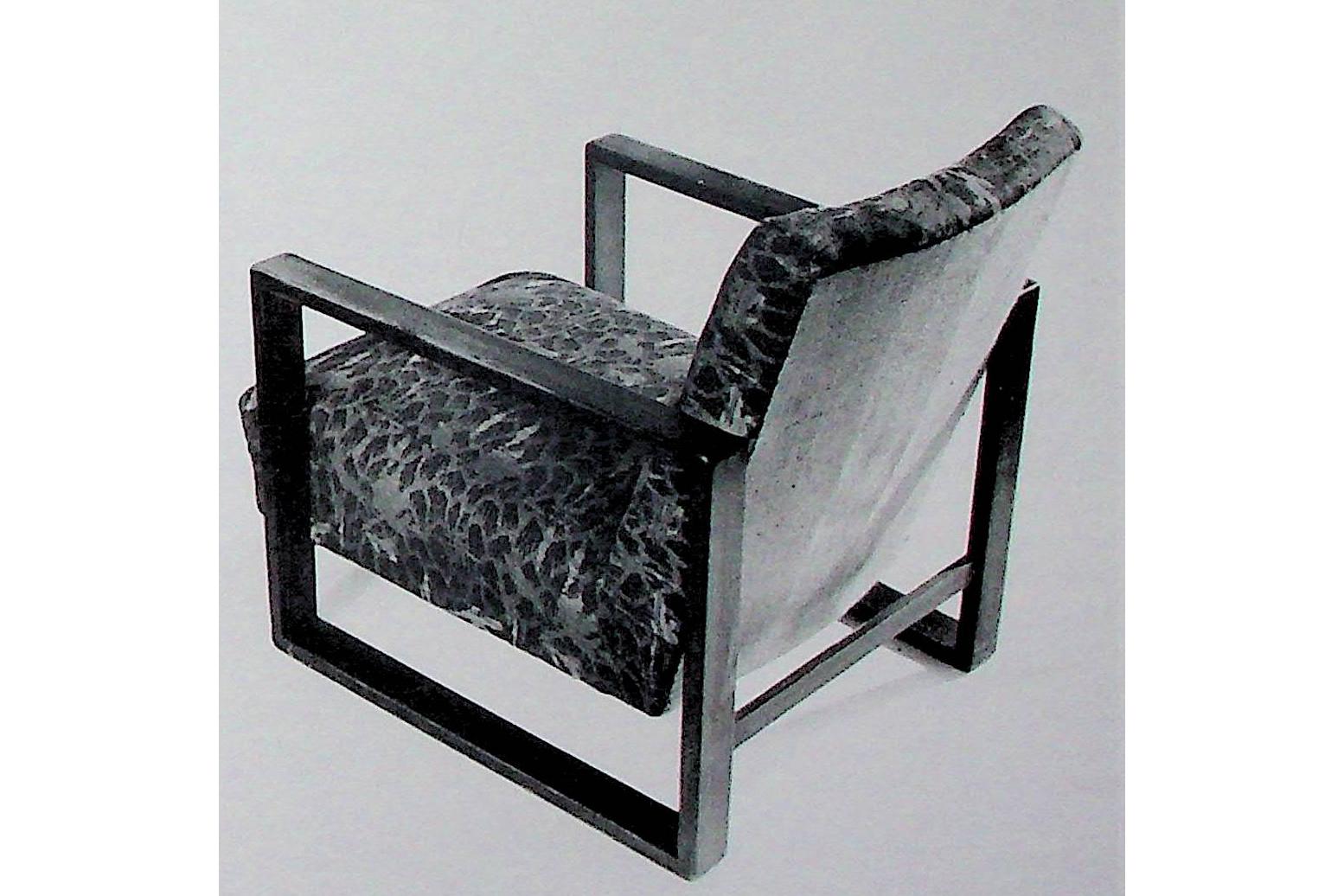
In 1931, at just seventeen years old, Wegner produced his first chair while still training as a carpenter. Remarkably modern in character, the chair featured a lightweight, cubic form defined by straight lines and a geometric structure. For a young man raised in a provincial town, the design demonstrates a clear awareness of international modernist currents.
This early chair already contains the seeds of what would later become Wegner’s lifelong pursuit: an aesthetic grounded in structure. There is no excess decoration—only clarity of construction, precise joints, and a form that derives its beauty directly from strength and necessity. The chair embodies the idea that structure itself can be expressive.
By contrast, the 1938 “First Chair,” now exhibited in Hans J. Wegner retrospectives, represents a further evolution of this thinking. While still rooted in structural exploration, it introduces a new concern: harmony with the human body. The form becomes more organic, with softened curves at the junctions between back and legs. Wood is no longer treated solely as a structural element but as a living material with elasticity and movement. Where the 1931 chair expressed structure through straight lines, the First Chair brings a sense of life into structure itself.
Turning Point: Copenhagen
In 1935, during his military service, Wegner traveled to Copenhagen and visited the annual exhibition of the Copenhagen Cabinetmakers’ Guild. There he encountered an entirely new world of furniture—one far beyond anything he had known before. The experience made him acutely aware of the need to further refine both his technical skills and his artistic vision.
This realization led him to study at the School of Arts and Crafts in Copenhagen, where he would later encounter Kaare Klint. Through this encounter, Wegner began his path toward the center of Danish modern furniture design, carrying with him the “memory of the hands” formed in Southern Jutland and an enduring respect for wood as both material and partner.
Related Articles
- Hans J. Wegner | A Master of Danish Furniture Design
- The Lost “First Chair” | Tracing the Origins of Hans J. Wegner’s Vision