What Is the Papa Bear Chair?
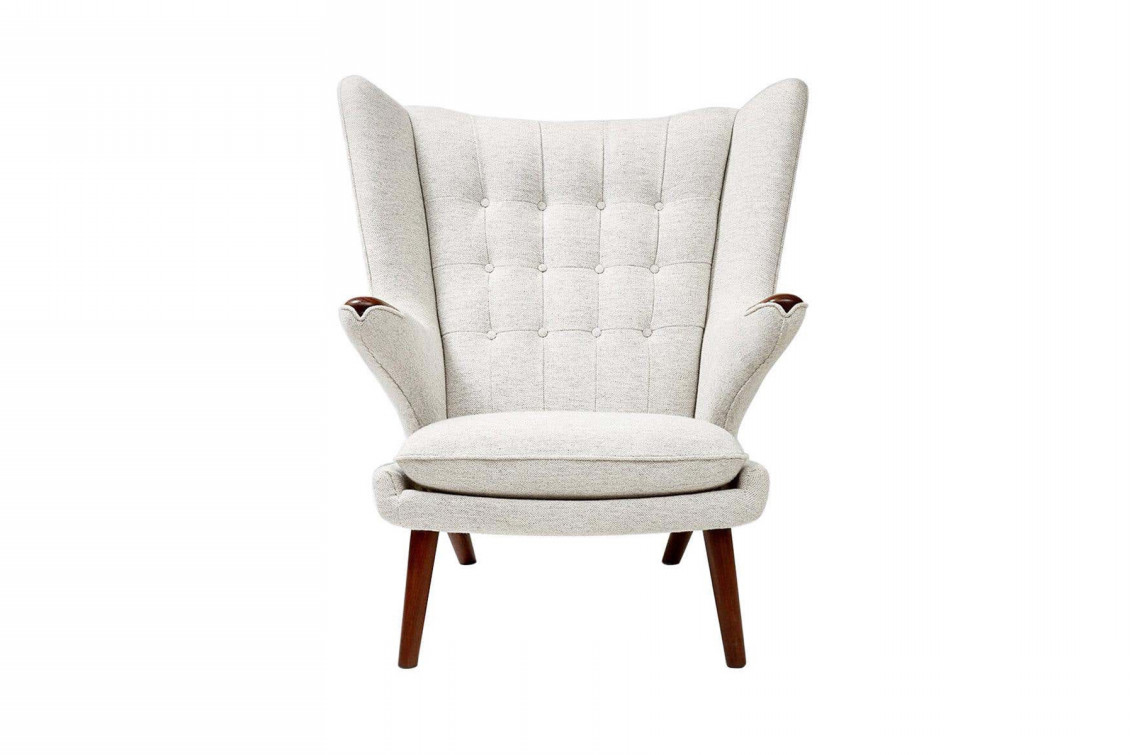
The Papa Bear Chair is a landmark lounge chair designed in 1951 by Danish master Hans J. Wegner. Its familiar nickname spread after the shape of the armrests was likened to the paws of a bear opening its arms for an embrace. The chair is formally known by the model numbers AP19 and PP19, but “Papa Bear Chair” has become established worldwide among design enthusiasts and architects as a name that captures its warmth and enveloping character.
Among the more than 500 chairs Wegner designed, the Papa Bear Chair is one of the works in which comfort, sculptural beauty and honesty of materials are most fully integrated. Its form is powerful yet organic, while the chair gently surrounds the sitter through a human-centered design. In that sense, it can be understood as more than furniture: it is an object in which the experience of the body and the art of form are closely connected.
Its fully upholstered construction and multilayered use of natural materials were highly innovative for the period and made possible an exceptional level of comfort. Through this chair, Wegner gave concrete form to his conviction that a chair should first and foremost serve the human being, bridging form and function, craft and industry, art and everyday life.
Within the history of Danish Modern design, the Papa Bear Chair is not merely a product but an emblem of its period and an icon of mid-century design. Its exceptional refinement has even led to descriptions such as the “Rolls-Royce of chairs.” Today it is shown in museums and galleries and is also traded at high prices in the international auction market.
The Design’s Origins and Its Two Authorized Manufacturers
The Papa Bear Chair dates to 1951, when Hans J. Wegner was at one of the most productive points of his career. During these years he was a central figure in the development of Danish furniture and, within a short period, created chairs now regarded as classics, including the Wishbone Chair (CH24), The Chair (PP501) and CH25.
In postwar Denmark, ideas such as high-quality materials, human-centered design and sustainable craftsmanship gained importance, and Wegner’s work developed in dialogue with those values. The Papa Bear Chair was unusual even within this context: rather than placing the beauty of an exposed timber frame at the center, it concealed much of the structure beneath upholstery and concentrated on an enveloping upholstered form.
The chair was also an important early example of a fully upholstered easy chair in Wegner’s work. It brought together the traditional skills he had acquired as a cabinetmaker with a new exploration of materials and upholstery, making it an ambitious step beyond the exposed-wood furniture for which he was already known.
Early Production: AP Stolen and Upholstery Craft
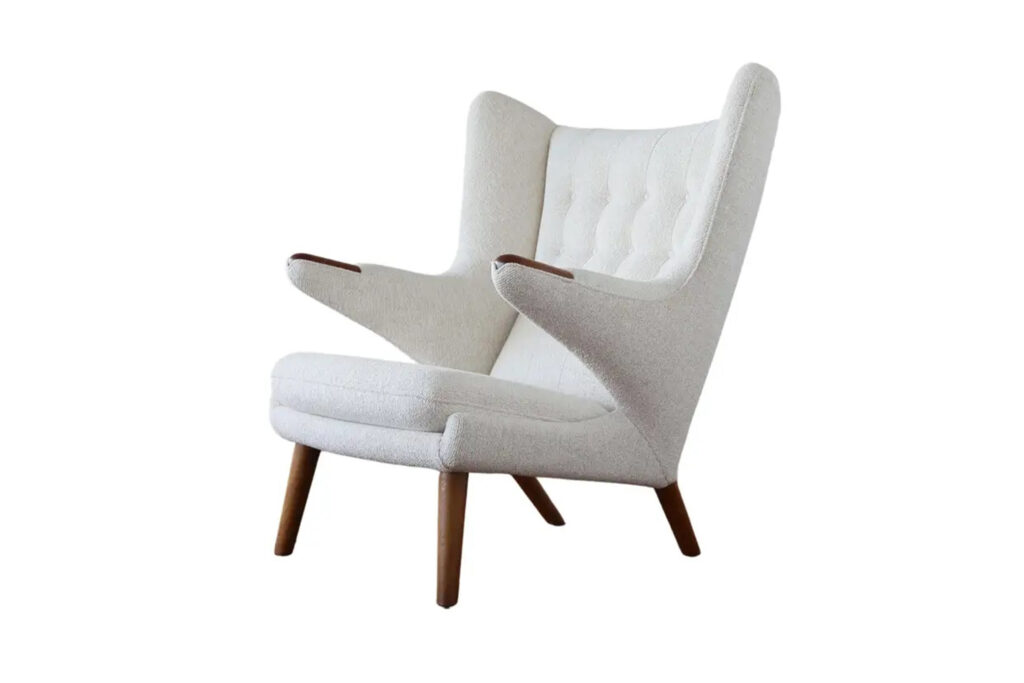
After its introduction in 1951, the Papa Bear Chair was first produced by AP Stolen, the Danish furniture workshop based in Herlev. Led by founder Anker Petersen, the company was particularly accomplished in upholstery and was one of the relatively few workshops specializing in fully upholstered furniture.
AP Stolen used a divided production system in which timber frames were commissioned from woodworking firms such as Kvetny & Søn, while upholstery and final finishing were carried out by AP Stolen itself. Wegner designed with this production structure in mind, placing emphasis on the sculptural possibilities of upholstery rather than on exposed timber construction. The Papa Bear Chair emerged from this close collaboration with AP Stolen.
Original AP Stolen Papa Bear Chairs from this period are highly regarded for the quality of their frames, upholstery and layered internal materials, and today they are among the most valued versions on the vintage market. AP Stolen closed in 1977, but the chairs it produced continue to be identified with the model number AP19.
Revival and Continuity: Production by PP Møbler
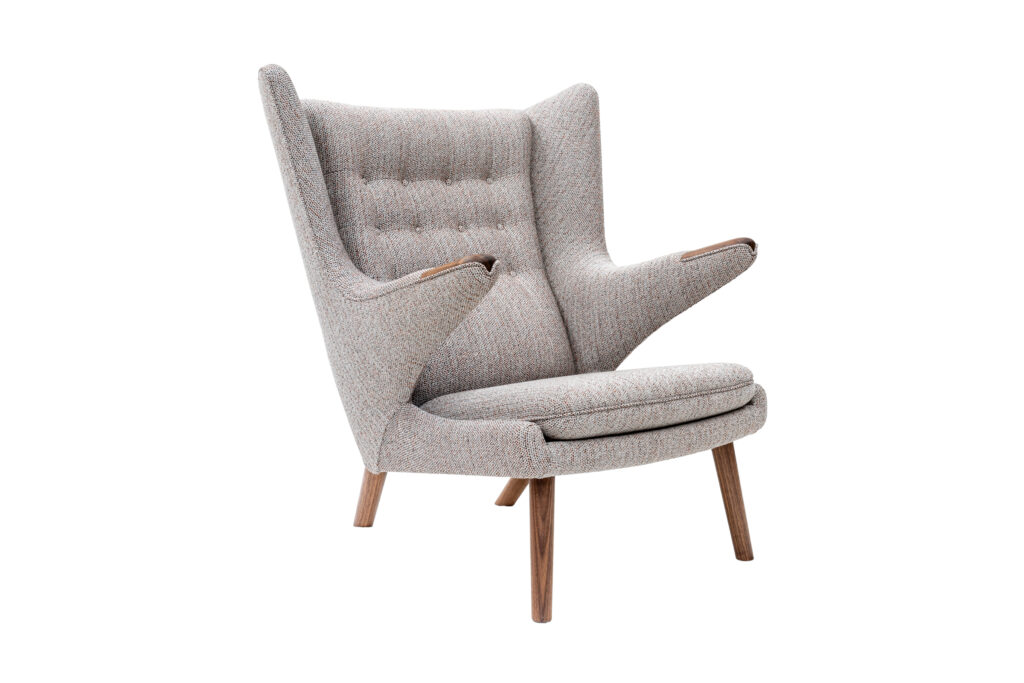
After AP Stolen closed, production of the Papa Bear Chair ceased for a period. In 2003, PP Møbler, the furniture workshop that had collaborated with Wegner for many years, brought the design back into production.
PP Møbler is known for preserving Wegner’s design philosophy, and the renewed production closely follows the original manufacturing approach. The frame is made from solid wood and the upholstery is completed by skilled craftspeople. High-density foam is used specifically in the seat cushion, while coil springs and natural filling materials remain important parts of the rest of the construction.
The current PP Møbler version is therefore not simply a visual reproduction. It carries forward the original design while incorporating contemporary standards of quality control and material selection. Production takes roughly two weeks per chair, with cutting, sewing and stuffing handled through intensive handwork by a craftsperson responsible for the chair’s completion.
More than seventy years after the design was created, the Papa Bear Chair therefore continues to be made with the same underlying philosophy and commitment to quality, maintaining a special place among furniture collectors, design enthusiasts and architects around the world.
Design Features and Structural Innovation

Internal Construction: Natural Materials and Precise Structure
The craftsmanship of the Papa Bear Chair is concentrated not only in its visible form but also inside the upholstery. Its internal construction combines natural materials with metal springs in multiple layers, creating the comfort and durability required for prolonged sitting.
Inside the backrest, coil springs are arranged to distribute pressure and provide natural resilience. Above and around them are layers of materials such as palm fibre, hemp, horsehair and cotton. Each contributes different qualities of ventilation, resilience and softness, producing a flexible and three-dimensional fit around the body.
The seat uses high-density urethane foam together with coil springs below. This combination balances resilience with support and helps the chair remain comfortable over long periods. Because the construction is assembled largely by hand, producing one chair requires about two weeks of work.
Sculptural Form and Functional Beauty
The exterior of the Papa Bear Chair is among the most sculptural forms of mid-century furniture. One of its most recognizable features is the continuous solid-wood element that visually connects the rear leg area to the tip of the arm. The open space beneath the arms allows the sitter to move the legs freely and accommodates a wider range of relaxed sitting positions.
The wooden tips of the arms were made in durable woods such as teak or rosewood. Their resistance to wear and pleasant tactile quality give them a practical role as well as a refined appearance. They are therefore not merely decorative details, but material choices intended to balance durability and use.
Twelve buttons are evenly arranged across the backrest. They create visual rhythm while also helping to hold the internal cushioning in place. The chair as a whole is characterized by the careful balance of curves and volume, bringing functional requirements and sculptural form together in a single composition.
Comfort and the Body: An Ergonomic Approach
One of the central attractions of the Papa Bear Chair is the deep sense of ease it provides when seated. The high, curved back supports the neck, shoulders, back and lower back, allowing the body to settle naturally into a relaxed posture.
The seat combines moderate sink with resilient support, avoiding a feeling that is either excessively soft or overly firm. The open space beneath the arms also makes it possible to cross the legs or sit at an angle, giving the user greater freedom to change posture.
Used together with the matching ottoman, the chair creates a complete resting posture with support for the feet, making it particularly suitable for reading or napping. Its ability to accommodate different body types and ways of sitting is one reason the Papa Bear Chair has remained widely admired for so long.
Market Value and Authenticity
Growing Value in the Vintage Market
The Papa Bear Chair has become one of the most closely followed pieces in the market for vintage Scandinavian furniture, and well-preserved original examples have achieved high prices at auctions around the world. Early AP Stolen chairs from the 1950s and 1960s are especially valued for their rarity and craft quality, and are often treated as objects that occupy the territory between functional furniture and collectible design.
Demand now extends beyond private collectors to architects, design practices and luxury hotels, where the chair is used as an interior object with cultural significance. This interest reflects not only fashion but also broader contemporary values concerning longevity, authenticity and the continued use of well-made objects.
Current PP Møbler Production and Its Position
PP Møbler Papa Bear Chairs produced since 2003 also remain highly sought after despite their position at the upper end of the furniture market. New examples have been priced at roughly ¥1.5–2 million depending on specification, and compared with vintage pieces they offer the reassurance of new condition and manufacturer support.
PP Møbler has worked closely with Hans J. Wegner’s family and estate, and the current chair is valued as an authorized continuation of the design in which materials, construction and manufacturing processes follow the original concept. As these chairs age, their long-term place in the collectible market is also likely to remain a subject of interest.
Reproductions and Counterfeits
The popularity of the Papa Bear Chair has also led to unofficial reproductions and misleadingly described pieces appearing on the market. This is especially important in the second-hand market, where imported or unidentified chairs may be presented in ways that suggest an authorized original. Reproductions can resemble the chair externally while differing substantially in structure, materials, weight and comfort. Authentic examples may retain a manufacturer’s stamp, label or, in the case of PP Møbler production, documentation, although such identifiers can be lost over time. Provenance and a clearly established seller therefore remain important when assessing a used chair.
A Chair with Collectible and Long-Term Value
The Papa Bear Chair offers satisfaction both as a chair to use and as an object to keep over time. AP Stolen examples and earlier PP Møbler production in particular are collected as works of furniture craft as well as functional objects. A carefully selected chair with reliable information and provenance can therefore become more than an interior furnishing: it can be passed from one generation to the next as a piece of design culture.

▶ Related article: Papa Bear Chair AP19 vs PP19 | Comparing AP Stolen and PP Møbler
A Chair Loved Across Generations

More than seventy years after its introduction, Hans J. Wegner’s Papa Bear Chair (PP19) continues to fascinate people around the world as a living classic and has secured a lasting place in the history of modern design. Its significance lies not only in the completeness of its furniture design, but in the unusually close integration of design philosophy, physical experience and craft value.
The chair’s essential appeal lies in its universality. Although designed in the 1950s, its form can sit naturally in minimalist interiors, Scandinavian Modern settings and contemporary architectural spaces. This adaptability comes from a search for fundamental comfort that responds directly to the human body and mind rather than relying on fashion or decoration.
The Papa Bear Chair does not merely avoid looking old; in many cases its appeal grows with age. Patina develops on the exposed wood, while upholstery and natural filling materials change through use. These traces of time allow the chair to develop in relation to its owner, giving it a quality of growth that is difficult to reproduce in more anonymous industrial products.
At PP Møbler, skilled craftspeople continue to make the chair largely by hand. The persistence of this process symbolizes the transmission of craft knowledge from one generation to the next. In this sense, production approaches a cultural activity as much as a manufacturing process, with each chair functioning both as a usable object and as part of a continuing design heritage.
At the same time, the chair’s position as a collectible has continued to strengthen. Examples are held in museum collections and are also used in private residences, luxury hotels and design offices. This broad range of settings reflects the way the Papa Bear Chair crosses the boundary between practical furniture and an object valued for its artistic and cultural significance.
A chair loved across generations is not simply a piece of furniture that lasts for a long time; it is one that continues to live alongside people’s sensibilities and cultural memory. The Papa Bear Chair embodies that quality, bringing beauty, comfort and accumulated time into the ordinary act of sitting. As it is used, restored and passed on, it continues to occupy interiors quietly but with unmistakable presence.