

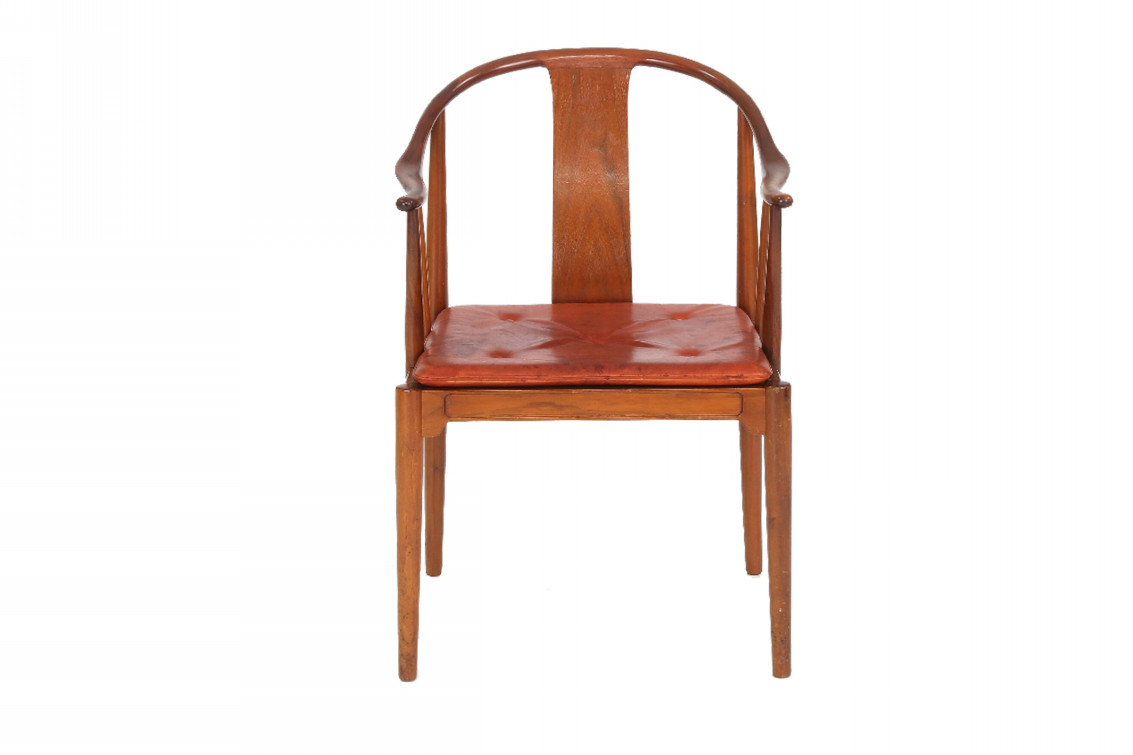
An early but decisive work
Designed in 1944, the Chinese Chair occupies a distinctive place in Hans J. Wegner’s body of work. Although it belongs to his early period, many of the ideas that later defined his most famous chairs are already clearly present here. Rather than a preliminary experiment, the Chinese Chair stands as one of the first moments where Wegner’s approach to chair design appeared in a fully formed way.
The chair is also unusual within the production history of Fritz Hansen. At a time when the company was developing industrial techniques such as bentwood and molded plywood, the Chinese Chair was produced as a solid-wood construction. This alone marks it as an exceptional collaboration, shaped more by the designer’s priorities than by standard manufacturing logic.
From a Chinese prototype to a Danish chair
The starting point for the Chinese Chair lies in traditional Chinese Ming-dynasty seating, particularly the yoke-back chair. Its continuous curve from backrest to armrest creates a sense of enclosure and calm authority. Wegner was deeply drawn to this form and studied it closely through museum examples.
However, the result is not a direct quotation. Wegner retained the essential idea of the continuous back-and-arm line, but reworked the structure so it would function within the logic of Scandinavian woodworking. Decorative elements were reduced, proportions simplified, and the overall form clarified. What remains is not a historical replica, but a chair that feels unmistakably Danish while still carrying the memory of its source.
Solid wood as a structural necessity
One of the defining characteristics of the Chinese Chair is its reliance on solid wood. For Fritz Hansen, this was an exception rather than the rule. For Wegner, however, it was essential. Trained originally as a cabinetmaker, he understood wood not as a surface material but as a structural one.
The carved crest rail, the smooth transition into the arms, and the precise joints connecting the legs all depend on the material’s natural strength and grain. Solid wood was not chosen for appearance alone; it was required to make the structure work. As a result, the chair carries a quiet tension—nothing is excessive, yet nothing feels arbitrary.
Two directions within the same idea
Within the broader history of the Chinese Chair, two tendencies can be observed. Early versions emphasize sculptural clarity and lightness, giving the chair a strong visual presence. Later interpretations simplify the structure further, placing greater emphasis on practicality and restraint.
These differences do not suggest indecision. Rather, they show Wegner’s habit of revisiting the same idea from multiple angles. The Chinese Chair demonstrates that his designs were not fixed solutions, but open structures—capable of refinement without losing their core identity.
A chair without a “back side”
Wegner famously insisted that a chair should look complete from every angle. The Chinese Chair reflects this belief with particular clarity. It is not designed to be pushed against a wall or viewed only from the front. From the back, from the side, or from an oblique angle, the lines remain coherent and resolved.
This quality allows the chair to function not only as a practical object, but as a presence within a room. It occupies space calmly, without relying on ornament, and asserts itself through proportion and construction alone.
An enduring point of reference
Although designed early in Wegner’s career, the Chinese Chair remains a key reference for understanding his later work. The dialogue between historical forms and modern life, the commitment to solid wood, and the insistence on structural clarity all reappear in his subsequent designs.
The chair’s lasting importance lies not simply in its elegance, but in the clarity with which it expresses Wegner’s way of thinking. From the beginning, his priorities were already set—and the Chinese Chair makes that unmistakably clear.